
Joint tissue support is the set of training, nutrition, and clinical practices aimed at the connective structures — tendons, ligaments, cartilage, and fascia — that carry load during exercise but adapt on a different schedule than muscle does. Muscle is richly vascular and responds quickly to training stress. Connective tissue has a sparser blood supply, and researchers have long observed that its turnover appears slower as a result.
That difference explains a pattern a lot of committed athletes recognize. Your legs feel fine. Your Achilles doesn't. You hit the session anyway, and the nagging thing in your shoulder is still there four weeks later — not bad enough to stop, not good enough to forget about.
We built BetterYu for people in exactly that position: still training hard, increasingly aware that recovery isn't free anymore, and looking for a legitimate clinical path instead of a workaround. Below is how we think about connective tissue — what the training side looks like, what the clinical side looks like, and where a licensed provider fits in.
Key Takeaways
- Connective tissue has a sparser blood supply than muscle, which is one reason tendon and ligament discomfort often lingers past the point where muscle soreness has cleared.
- Persistent joint discomfort can be associated with recognized medical conditions — inflammatory arthritis, thyroid disorders, vitamin D or iron deficiency, and structural injury among them — and deserves proper evaluation.
- CELL MEND, REBUILD and RESTORE sit in BetterYu's Recovery & Repair category and ELEVATE sits in Muscle & Performance — training capacity, recovery between sessions, and day-after readiness; a licensed provider decides case-by-case whether any prescription therapy is appropriate.
- Compounded medications are not reviewed or approved by the FDA before they are dispensed, and are used only under licensed-provider supervision.
- States with licensed providers are shown on our live coverage map; BetterYu delivers care through asynchronous telehealth, and availability can change.
Why does connective tissue lag behind muscle?
Connective tissue lags behind muscle largely because of vascularity. Muscle is dense with capillaries; tendon, ligament, and cartilage are comparatively avascular, and researchers have proposed that limited blood flow constrains how quickly nutrients and repair signaling reach those structures after loading.
The practical consequence is a timeline mismatch. Your cardiovascular system adapts to a new training block quickly. Your muscles follow. Your tendons are still catching up — which is why load progression that feels conservative to your lungs can feel aggressive to your patellar tendon.
Age adds another variable. Collagen composition and tissue hydration change over time, and the research literature on connective tissue aging is still developing. None of this is a verdict on what your body can do. It's context for why the same training that used to feel routine now leaves a joint talking to you for days.
Persistent soreness in a joint isn't a character flaw or a sign you've gotten soft. It's a tissue with a different recovery clock than the muscle sitting on top of it. — The BetterYu Clinical Team
When does joint discomfort need a medical evaluation?

Joint discomfort warrants medical evaluation when it persists, worsens, appears without a clear training cause, or comes with swelling, warmth, redness, locking, instability, or systemic symptoms like fever, fatigue, or unintended weight change.
Joint pain and slow recovery can be associated with recognized medical conditions — inflammatory or autoimmune arthritis, gout, thyroid disorders, vitamin D or iron deficiency, diabetes, sleep apnea, medication side effects, and structural injuries such as meniscal or labral tears. Several of these are identifiable with standard evaluation and imaging, and several change what appropriate training looks like.
Start there. A wellness program is not a substitute for working out what's actually going on in a joint that isn't behaving. BetterYu's independently licensed providers would rather you arrive at an intake with that groundwork done.
What does joint tissue support look like in training?
In training, joint tissue support means managing load in a way that respects connective tissue's slower adaptation curve — progressing volume and intensity gradually, using tempo and isometric work, and treating deload weeks as programming rather than weakness.
A few principles our care team sees hold up across sport:
- Progress one variable at a time. Adding volume, intensity, and frequency in the same week gives you no way to identify what a joint objected to.
- Use slow eccentrics and isometric holds. Both are widely used in tendon rehabilitation and can often be loaded when faster, higher-impact work can't.
- Warm up the specific joint, not just the system. Ten minutes of the movement pattern under light load prepares tissue that a general cardio warm-up doesn't reach.
- Treat deloads as scheduled, not earned. Waiting until something hurts to back off means the decision gets made for you.
Modifying a session isn't scaling back your identity as an athlete. It's the thing that keeps you training in five years. If you're navigating a specific nagging issue, our practical guidance on training through minor injuries goes deeper on how to adjust without stopping entirely.
What role do nutrition and sleep play in tissue health?

Nutrition and sleep supply the raw material and the recovery window that connective tissue repair depends on. Collagen is a protein structure, and protein intake, vitamin C status, and overall energy availability are all recognized inputs into tissue maintenance.
Under-fueling is common among athletes who train a lot and eat by habit rather than by demand. When energy availability drops, the body triages — and tissue maintenance is rarely the first priority. Hydration matters too, since cartilage and intervertebral discs rely on fluid for their mechanical properties.
Sleep is the one people skip. Most of the body's restorative signaling happens during deep sleep, and chronically short nights compress that window. If poor sleep is the constant in your recovery equation, that's worth raising with a licensed provider — persistent sleep disruption can also point to conditions like sleep apnea that deserve their own workup.
Connective tissue is built from protein. Chronic under-fueling reduces what's available for maintenance and repair.
Restorative signaling concentrates in deep sleep. Short nights compress the window your tissue has to work with.
Cartilage and discs depend on fluid content for load tolerance, which makes hydration a structural issue, not just a performance one.
Where does clinically supervised therapy fit?
Clinically supervised wellness therapy is one option for people who have already addressed training load, nutrition, and sleep and want to explore additional provider-guided support. BetterYu delivers a prescription wellness program through pre-filled pens organized by goal: Energy & Metabolic, Recovery & Repair, Muscle & Performance, Body Composition, and Skin, Hair & Longevity.
For training-related recovery, CELL MEND, REBUILD and RESTORE sit in Recovery & Repair, and ELEVATE sits in Muscle & Performance — training capacity, recovery between sessions, and day-after readiness. Which pen — if any — is appropriate is a clinical decision made case-by-case by BetterYu's independently licensed providers after reviewing your intake, with contents directed by the provider, not something you select from a menu.
| What matters | Unregulated online source | BetterYu |
|---|---|---|
| Licensed provider reviews your case | No clinical oversight | Yes |
| Patient-specific label and prescriber of record | Provided | State-licensed pharmacy |
| Pre-measured, no preparation | No | Yes |
| Third-party compliance review | None | LegitScript Healthcare Merchant Certification |
To be direct about the two questions we hear most: this is a legitimate prescription pathway, not a workaround, and prescriptions are filled by a state-licensed pharmacy compounding patient-specific prescriptions under section 503A of the Federal Food, Drug, and Cosmetic Act and applicable state requirements. Compounded medications are not reviewed or approved by the FDA for safety, effectiveness, or quality before they are dispensed, and a licensed provider determines whether a compounded prescription is appropriate for you. Products from unverified online sources are a separate category entirely — identity, purity, potency, sterility, labeling, and accountability may all be unknown.
How does BetterYu work, start to finish?
BetterYu operates as an asynchronous telehealth platform: you complete an online intake, BetterYu's independently licensed providers review it, and if treatment is clinically appropriate, a prescription is written and filled by a state-licensed compounding pharmacy and shipped to you.
You're asked to disclose all medications, supplements, and any previously self-directed products so the provider can evaluate safety accurately. That disclosure isn't a test — it's how an individualized plan gets built. You choose a single pen, paid once, or a 3- or 4-month subscription billed monthly for its term, and neither renews automatically. Your provider sets the plan.
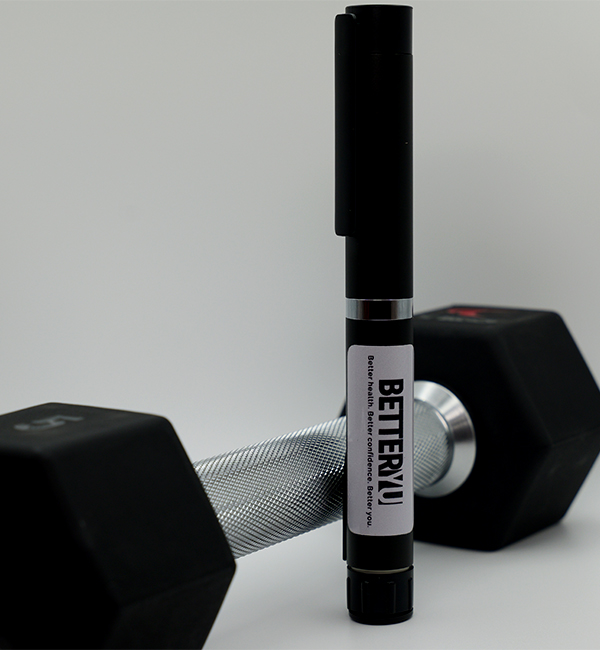
The pen design removes the preparation step entirely — pre-measured, concealed needle, nothing to mix or calculate.
Eligibility depends on your physical location at the time care is provided — not a mailing address — and on whether a provider is licensed or otherwise legally authorized to practice there, plus pharmacy service availability. Coverage can change, so check the live coverage map rather than assuming. For a broader view of how we approach this category, our Recovery & Repair page covers the surrounding context.
Frequently asked questions
Why do joints take longer to recover than muscles?
Joints and the connective tissue around them have a sparser blood supply than muscle, and researchers have proposed that limited vascularity constrains how quickly repair processes proceed. Muscle adapts on a faster curve, which is why a joint can still be complaining after the surrounding muscle feels fine. If a joint stays uncomfortable, discuss it with a licensed provider.
What supports joint and tissue health?
Gradual load progression, adequate protein and total energy intake, hydration, consistent sleep, and scheduled deloads are the foundational inputs. For those who've already optimized those and want to explore additional provider-guided support, clinically supervised wellness therapy is one option — candidacy is determined case-by-case through an intake reviewed by BetterYu's independently licensed providers.
Should I train through joint discomfort?
That depends on what's causing it, which is why discomfort that persists, worsens, or comes with swelling, instability, or locking should be evaluated before you decide. Many athletes modify rather than stop — adjusting load, range, or tempo. A licensed provider can help you work out which category you're in.
What role does nutrition play in tissue health?
Connective tissue is built largely from collagen, a protein structure, so protein intake, vitamin C status, and overall energy availability are recognized inputs into tissue maintenance. Chronic under-fueling gives the body less to work with. Discuss nutrition concerns and any deficiency symptoms with a licensed provider during your intake.
When should I talk to a provider about recovery?
Talk to a provider when discomfort persists beyond a normal recovery window, when it appears without a clear training cause, or when it comes with swelling, warmth, fatigue, or other systemic symptoms. Joint pain and slow recovery can be associated with conditions like inflammatory arthritis, thyroid disorders, or nutrient deficiency. BetterYu's intake is reviewed by a licensed provider, and completing it does not guarantee treatment or a prescription.
This article is educational. It does not provide a diagnosis or an individual treatment recommendation. Prescription products are used only under the supervision of a licensed provider, and you should discuss your own health history, symptoms, and current medications with a provider before making any changes.